
Construction site compliance is the process of meeting all applicable Australian laws, safety standards, building codes, and documentation requirements across every stage of a construction project. The formal industry term is work health and safety compliance, governed primarily by the Work Health and Safety Act 2011 and administered by Safe Work Australia. For site managers, understanding what is construction site compliance means knowing that it covers far more than wearing a hard hat. It spans structural inspections, environmental permits, worker training records, and real-time hazard reporting. Get it right, and your project runs on time. Get it wrong, and you face stop-work orders, fines, and serious legal exposure.
What is construction site compliance and why does it matter?
Construction site compliance is defined as the ongoing adherence to all regulatory obligations that apply to a construction site, including safety law, building codes, environmental rules, and labour standards. The layered nature of these regulations means zoning limits, building codes, safety standards, environmental permits, and labour laws often apply simultaneously. That overlap is where most site managers get caught out.
Safe Work Australia sets the national framework, but each state and territory enforces its own WHS legislation. The National Construction Code (NCC) governs structural and fire safety requirements. Environmental Protection Authorities in each state add another layer for waste, noise, and contamination. Managing all three at once requires a deliberate system, not a last-minute scramble before an inspection.
The importance of site compliance goes beyond avoiding fines. A compliant site is a safer site. Workers go home at the end of the day, projects stay on schedule, and your business reputation stays intact. Non-compliance, by contrast, triggers investigations, compensation claims, and in serious cases, criminal prosecution of the principal contractor.
What are the main categories of construction compliance requirements?
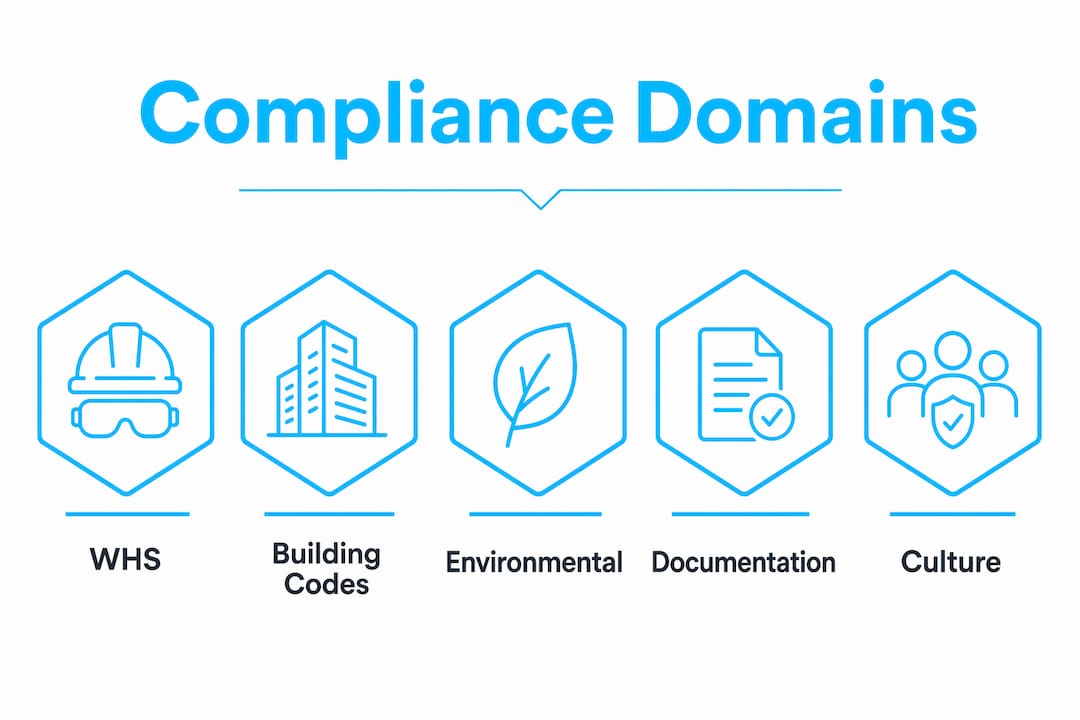
Construction compliance requirements fall into four broad categories. Each one carries its own obligations, documentation demands, and inspection triggers.
Work health and safety (WHS)
WHS obligations under the Work Health and Safety Act 2011 require you to eliminate or minimise risks so far as is reasonably practicable. This includes providing safe plant and structures, safe systems of work, adequate training, and suitable supervision. Safe Work Method Statements (SWMS) are mandatory for high-risk construction work, covering tasks like working at heights, excavation, and demolition.
Building and structural codes
The NCC sets minimum standards for structural integrity, fire resistance, energy efficiency, and accessibility. Compliance with the NCC is not optional. Local councils enforce it through the building permit and inspection process, and inspections must follow a mandatory sequence such as foundation inspection before concrete pour and framing before drywall. Skipping a step forces removal of completed work.
Environmental regulations
Sites must manage stormwater runoff, dust, noise, and waste disposal according to state environmental protection laws. Sediment fences, concrete washout areas, and noise management plans are common requirements on residential builds. Breaching environmental conditions can result in penalties separate from any WHS infringement.
Documentation and permits
Every compliant site runs on paperwork. Development approvals, building permits, SWMS, site safety management plans, and inspection certificates must all be current and accessible on site. Gaps in documentation are the most common reason sites fail audits.
-
Obtain all permits before breaking ground
-
Keep SWMS current and signed by workers before high-risk tasks begin
-
Store permits, approvals, and inspection certificates in one accessible location on site
-
Update your site safety management plan when site conditions change
Pro Tip: Set a weekly reminder to review your permit expiry dates. An expired permit discovered mid-pour is a costly problem that takes minutes to prevent.
Which key documents and records are essential for site compliance?
Compliance documentation is the primary shield against legal liability. Firms with rigorous, regularly updated logs fare significantly better in unannounced audits than those scrambling to reconstruct records after the fact.
The following documents are non-negotiable on any compliant Australian construction site:
-
Safe Work Method Statements (SWMS): Required for all high-risk construction work. Must be prepared before work starts, signed by workers, and reviewed when conditions change.
-
Site safety management plan: A project-level document outlining how WHS risks are managed across the full build. Updated as the project progresses.
-
Incident and near-miss reports: All incidents must be recorded. Fatality reporting must occur within 8 hours of the event. Near-miss documentation is a proactive risk mitigation tool that inspectors look for.
-
Training and induction records: Worker training records are heavily scrutinised by inspectors and act as a legal defence. They show that workers were prepared for specific tasks before they performed them.
-
Inspection certificates and permits: Foundation, framing, and waterproofing inspections must be signed off in sequence. Keep originals or certified copies on site.
-
Hazard identification logs: Daily or task-based hazard assessments that show ongoing risk management, not just a one-off plan at project start.
Retention periods matter. Training records, incident reports, and SWMS should be retained for the duration of the project and for a minimum period after completion as required by your state regulator. Audit-ready filing means you can produce any document within minutes, not hours.
Pro Tip: Organise your compliance documents by category and date, not by trade or subcontractor. Inspectors work through categories, and so should your filing system.
What are the most common compliance hazards on Australian construction sites?
The Fatal Four are the leading causes of construction fatalities in Australia and internationally: falls from height, struck-by incidents, electrocution, and caught-in or caught-between incidents. Falls alone cause 33.5% of all construction fatalities, and fall protection consistently leads all categories for safety citations year after year. That statistic tells you where your greatest exposure sits.
Beyond the Fatal Four, the most common compliance failures on Australian sites include:
-
Inadequate PPE: Workers not wearing or being provided with appropriate personal protective equipment for the task
-
Poor hazard communication: Failure to display safety signage, update hazard registers, or brief workers on changed site conditions
-
Scaffolding deficiencies: Incomplete handrails, missing toe boards, or scaffolding erected without a competent person sign-off
-
Electrical safety lapses: Untagged leads, damaged power tools, or work near live services without safe work procedures
-
Housekeeping failures: Cluttered walkways, unsecured materials, and inadequate waste disposal that create trip and struck-by hazards
The reason these violations recur is straightforward. They are visible, daily risks that get normalised over time. A site that ran fine last week can become non-compliant today because a subcontractor changed a work practice or a piece of equipment arrived without the right documentation. Compliance is not a state you achieve once. It is a condition you maintain every day.
How can site managers maintain continuous compliance throughout a project?
Continuous compliance requires daily habits, not periodic reviews. Treating compliance as an ongoing operational discipline rather than a reactive burden is what separates sites that run smoothly from those that attract stop-work orders.
Daily safety checklists and walkthroughs
A pre-shift walk-through typically takes 10 to 15 minutes to complete and covers PPE, fall protection, scaffolding, electrical safety, equipment condition, hazard communication, housekeeping, and emergency preparedness. That 15 minutes is the single most cost-effective compliance activity on any site. It catches hazards before they become incidents and creates a daily record of your due diligence.
Align inspections with build milestones
Failing to align safety plans with actual site logistics during the design phase leads to costly rework and stop-work orders. Verify your inspection schedule with your local building authority before you lock in subcontractor scheduling. A framing inspection that falls on a public holiday or gets missed because the inspector was not booked can delay your entire programme by weeks.
Train workers and keep the records
Training is a strong predictor of safety performance on site. Every induction, toolbox talk, and task-specific training session must be recorded with the date, content, and worker signatures. When an inspector arrives, your training records are the first thing they check.
Use a centralised documentation system
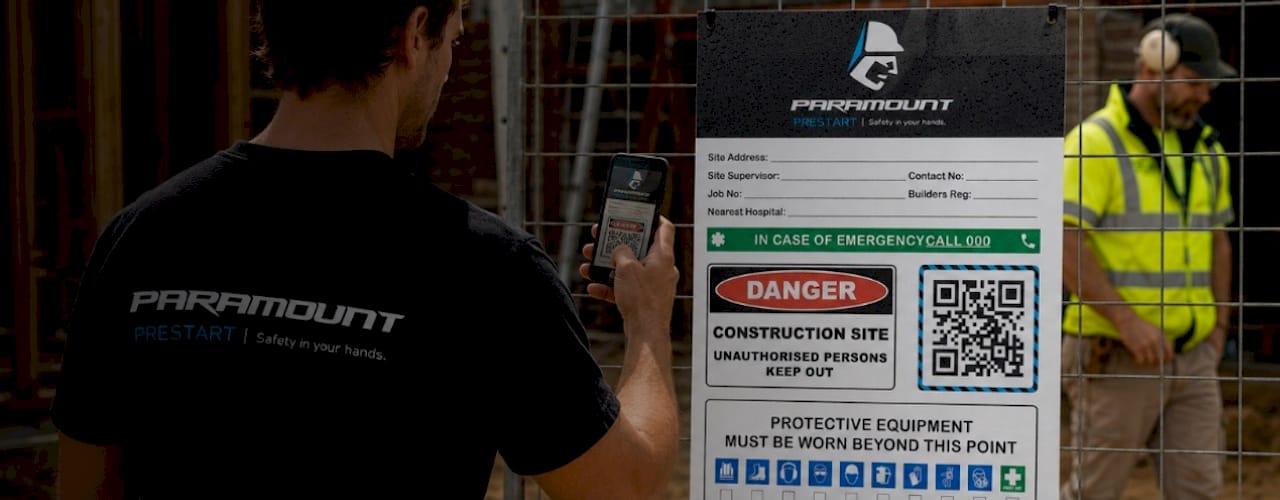
Paper-based filing fails under the pressure of a busy site. Digital systems that capture SWMS, inspection checklists, hazard reports, and incident notifications in one place give you audit-ready records at any time. Paramountprestart is built specifically for this purpose, letting site managers and subcontractors complete digital safety forms from their phones on site.
The practical difference between a compliant site and a non-compliant one often comes down to whether documentation is current and accessible. A site safety management plan written in month one and never updated is not a compliance document. It is a liability.
Key takeaways
Construction site compliance requires daily operational discipline across safety, documentation, and inspection management to protect workers and avoid legal penalties.
| Point | Details |
|---|---|
| Compliance covers four domains | WHS, building codes, environmental rules, and documentation all apply simultaneously on Australian sites. |
| Documentation is your legal defence | Firms with current, audit-ready records fare better in unannounced inspections and legal proceedings. |
| The Fatal Four drive most fatalities | Falls, struck-by, electrocution, and caught-in incidents cause nearly 60% of construction deaths. |
| Inspections follow a mandatory sequence | Foundation before pour, framing before drywall. Missing a step forces removal of completed work. |
| Daily checklists prevent violations | A 15-minute pre-shift walk-through creates a daily record and catches hazards before they escalate. |
Compliance is not a checklist. It is a culture.
I have seen sites where the safety folder is immaculate and the site is a mess. The documents exist, but nobody uses them. That is the most common compliance failure I encounter, and it is also the most dangerous, because it creates a false sense of security.
The sites that genuinely perform well on compliance audits are the ones where the site manager treats documentation as a daily work habit, not a box-ticking exercise before an inspection. They brief their subbies every morning. They update their hazard register when a new trade comes on. They record near-misses without being asked, because they understand that a near-miss today is a fatality next week.
Pre-construction integration of compliance plans with actual site logistics is where most of the value sits. If your safety plan does not reflect how the site actually operates, it will not protect you when something goes wrong. Write it for the site you have, not the site you imagined at tender stage.
The other thing I would say is this: stop treating compliance audits as adversarial events. An inspector who finds a gap is doing you a favour. They are identifying a risk before it becomes a claim, a prosecution, or a funeral. The site managers who understand that tend to have far fewer problems in the long run.
— Adam
Paramountprestart makes site compliance manageable
Keeping up with compliance documentation on a busy residential build is genuinely hard work. Forms get lost, signatures get missed, and records end up scattered across email threads and paper folders.
Paramountprestart puts your safety compliance tools in your pocket. Site managers and subcontractors can complete SWMS, site inspection checklists, hazard and incident reports, and full site safety management plans directly from their phones on site. Every form is stored digitally, timestamped, and ready for audit at any time. No chasing signatures. No lost paperwork. Just a clear, current compliance record every day of the build.
FAQ
What does site compliance mean in construction?
Site compliance means meeting all applicable laws, codes, and standards that govern how a construction site operates. This includes WHS obligations, building code requirements, environmental permits, and documentation standards.
What are the main construction compliance requirements in Australia?
Australian construction sites must comply with the Work Health and Safety Act 2011, the National Construction Code, state environmental protection laws, and local council permit conditions. Each applies simultaneously and requires integrated management.
How do compliance audits in construction work?
Compliance audits involve an inspector reviewing your documentation, observing site conditions, and checking that work matches approved plans and permits. Maintaining an audit-ready filing system with daily updated logs is the most effective way to pass unannounced inspections.
What is the most common construction site violation in Australia?
Fall protection is the most frequently cited violation on construction sites. Falls cause 33.5% of all construction fatalities, making height safety the highest-priority compliance area on any residential or commercial build.
How do I ensure site compliance on a daily basis?
Complete a pre-shift safety walk-through each morning, keep all SWMS current and signed, record any incidents or near-misses immediately, and verify that your inspection certificates are in sequence before each build milestone.